Foundation model for SAR imagery
using MAE for pretraining a ViT backbone on SAR data
---
Highlights
-- Developed a SAR imagery foundation model using Masked Autoencoders (MAE) for feature learning.
-- Pre-trained Vision Transformer (ViT) on AI4Arctic dataset with MAE, fine-tuned for segmentation.
-- Achieved 5% F1-score increase over UNet benchmark with only 50% labeled data.
-- Model learned SAR features and irregular objects like ice, water, and land.
---
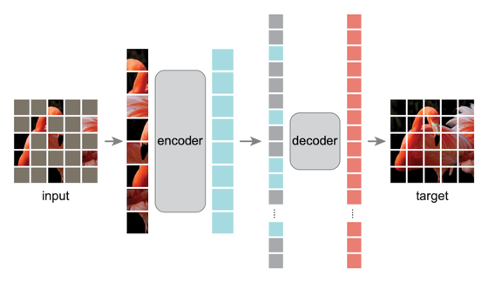
Schematics of MAE. Input patches are masked, and the deep learning model is asked to recover the masked patches.
I applied the MAE pre-training strategies and surprisingly, the regeneration results are quite impressive. Since our SAR signals are images of Earth's surface (Canadian Arctic in our case), I thought the deep learning model wouldn't be able to regenerate irregular objects like ice shapes, rocks, and water. But the results below prove otherwise:
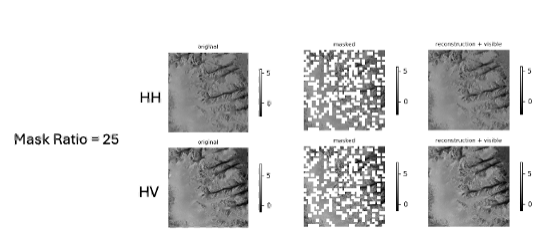
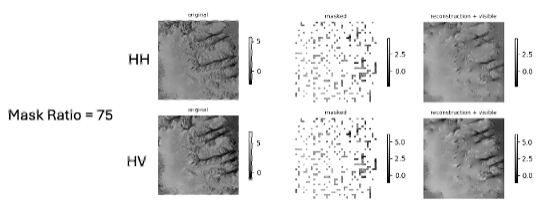
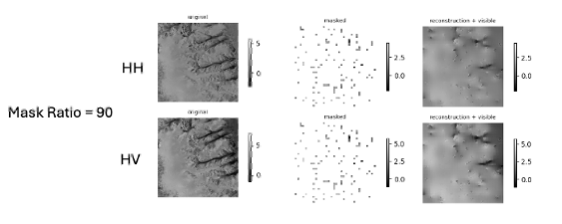
The above images show the regeneration quality with different mask ratios. Increasing the mask ratio leads to a loss of crucial information necessary for accurately reproducing features such as the crack lines (black lines), resulting in incorrect representations of their lengths.
Next, let's investigate the effect of pre-training on a downstream task (semantic segmentation of Sea Ice age).
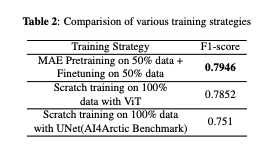
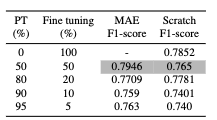
Figure (a) shows the effect of different pretraining strategies. Figure (b) shows the effect of % of pretraining vs fine-tuning data.
Lastly, let's visualize the segmentation quality using the pre-trained model.
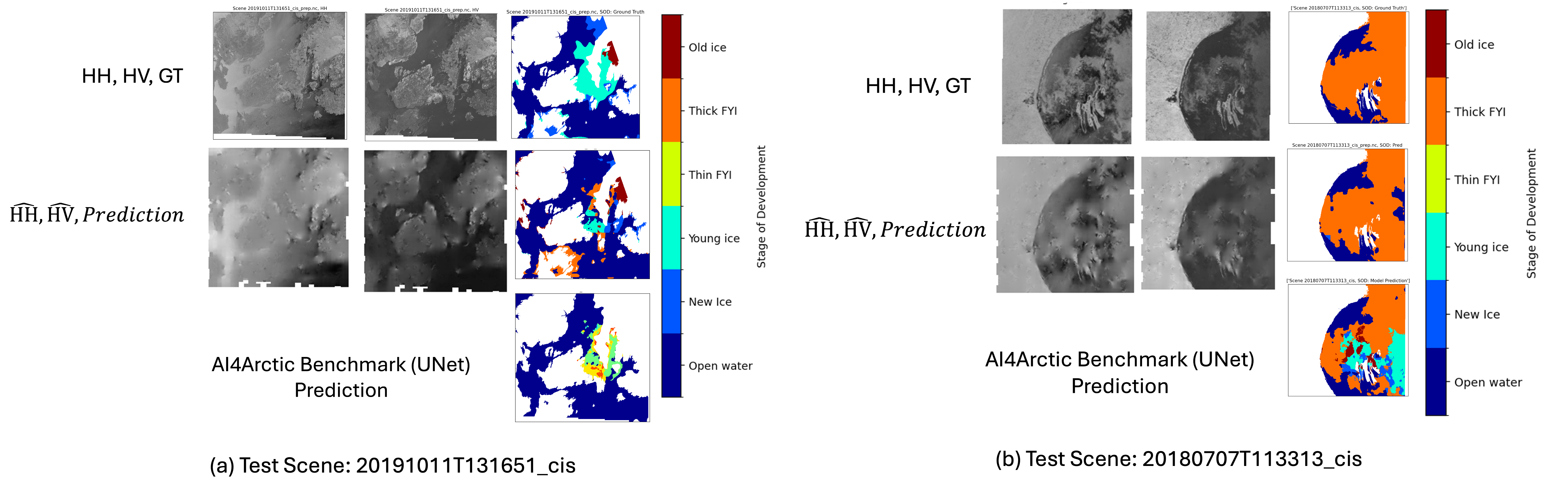
Segmentation visualization of SOD on two test scenes. The first row shows the Original HH, HV, and Ground truth, the second row shows the reconstructed HH, HV from a 75% masked image, and the third row shows the prediction of the AI4Arctic benchmark model. The land area is filtered out in the segmentation maps.